

THERE ARE STORIES that arrive like thunder, all at once, demanding ink. And then there are the quieter ones—the kind that slip into your life, sit down beside you, and wait. Forty years, if that’s what it takes.
This one began on an afternoon dressed in black.
In the spring of 1986, I found myself at the funeral services for Patricia Schallert, the wife of my late agent, gone far too young at 57. The kind of number that doesn’t feel like an ending so much as an interruption. After the church, there was the soft murmur of a reception, the clink of glasses, the subdued choreography of grief trying to behave itself.
And there, as if placed by a novelist with a taste for coincidence, I struck up a conversation with the man next door—Edwin Blum.
Blum had the air of someone who had lived several lives and remembered all of them. He knew I was a columnist, knew I was new enough to Los Angeles to still be listening carefully. So he leaned in—not conspiratorial, not quite—and began to talk about the house. His house. A place he had purchased years earlier from Joseph P. Kennedy Sr.. A place, he said, where the patriarch of America’s most mythologized political family had conducted a romance with Gloria Swanson that belonged as much to Hollywood as it did to history.
He didn’t just tell it. He staged it. Rooms became scenes. Hallways carried whispers. He even spoke—casually, as though discussing the weather—of a child.
At the time, I heard it the way a newspaperman hears everything: as a column, maybe a feature, something tethered to fact, to proof, to the discipline of what could be nailed down and printed. And that was the problem. The story resisted being nailed down. It shimmered. It suggested. It refused to sit still long enough to be labeled nonfiction.
So I let it go.
Or thought I did.
Because some stories do not leave. They change shape. They bide their time. They wait for you to catch up to them.
Years passed. Books were written. Lives intersected and moved on. But that afternoon on Rodeo Drive—those rooms, that rumor, that almost-child—remained like a faint watermark beneath everything else. And slowly, almost without permission, it began to ask a different question.
What if?
What if the most famous political family in America had carried, just out of sight, another son?
We know the public mythology. John F. Kennedy, the fragile younger brother, the “spare” who became the heir after the golden boy, Joseph P. Kennedy Jr., was lost in the war. We know the father’s ambitions, vast enough to feel architectural. We know the way history arranged itself around absence, around tragedy, around the sudden shifting of destiny from one son to another.
But fiction has its own kind of truth, and it lives in the spaces history leaves untouched.
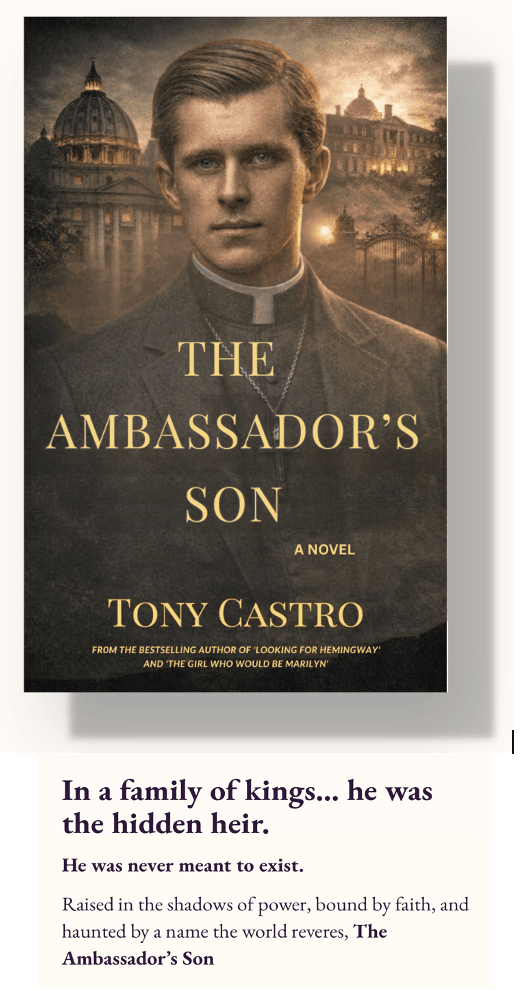
The Ambassador’s Son was born in that space.
In the novel, the Kennedy–Swanson liaison does not end in rumor or half-light. It produces another life. Another boy. Not erased, not entirely hidden, but raised at a distance—in Rome, in London, in Los Angeles—moving along the edges of power while never fully stepping into its glare. A child recognized in ways that are quiet, complicated, and, in the world of the book, sanctioned by both church and state.
His name is Patrick.
And if the known sons of that family were shaped by expectation and ambition, Patrick is shaped by something else entirely. He grows not as the heir, not even as the spare, but as the observer. The one who sees the machinery from the outside and understands its cost. If there is such a thing as a conscience in a dynasty built on will and velocity, it belongs to him.
He is, in a sense, the answer to a question history never quite asked.
Looking back now, it feels almost inevitable that the story could not have been written then. I was too close to the surface of things, too bound by the rules of reporting, too eager to confirm what could only be imagined. The younger version of myself was chasing facts. The older one has learned to listen for echoes.
That afternoon in 1986 was not a missed opportunity. It was an opening line.
It just took forty years to find the rest of the sentence.
TONY CASTRO, the former award-winning Los Angeles columnist and author, is a writer-at-large and the national political writer for LAMonthly.org. His forthcoming biography about Marilyn’s childhood and youth, THE GIRL WHO WOULD BE MARILYN MONROE, will be published in September by Bloomsbury. He can be reached at tony@tonycastro.com.