

FOR MUCH OF MY YOUTH, Pancho Gonzales existed somewhere off to the side of American greatness, visible but oddly unattended, like one of those weathered statues in a city park that people pass every day without ever stopping to read the inscription.
In Texas in the 1950s and early ’60s, my sporting imagination belonged mostly to Mickey Mantle and the Yankees. Baseball ruled everything. Tennis still felt distant, country club exotic, even when the greatest tennis player in the world happened to be a Mexican-American kid from Los Angeles named Ricardo Alonso Gonzales.
Or perhaps especially because of that. At the age of 20, in 1948, Pancho won the US Nationals at Forest Hills, which became the US Open in 1968. He won the tournament again in 1949, soon turned pro and for over a decade beginning in the 1950s, ruled tennis as the No. 1 player in the world.
By the time I first encountered Pancho in person as a young sportswriter for the Waco Tribune-Herald in 1967, he was already carrying the strange burden reserved for certain athletes: still famous, still dangerous, still capable of brilliance, yet somehow treated as yesterday’s story before the story had fully ended.
I had been sent to Fort Worth to cover Gonzales at Colonial Country Club and to write about the coming revolution in tennis. The Open Era was approaching, and for the first time professionals like Pancho would finally be allowed back into the Grand Slam tournaments from which they had effectively been exiled during their prime years. Younger fans today can scarcely imagine such a thing, but for years the best players in the world were barred from Wimbledon and Forest Hills simply because they played professionally for money.
Pancho had spent much of his greatest tennis life wandering in exile.
He was nearing forty then. Lean. Coiled. Volcanic.
And yes, the temper was real.
You could feel it before it fully surfaced, like static electricity gathering around a storm. Pancho argued with line calls, muttered at himself, glared at opponents and spectators alike. But what struck me even then was not merely the anger. It was the loneliness behind it. He moved through tennis with the wary vigilance of a man who had spent too much of his life being told he did not quite belong.
A year later, in 1968, the Open Era finally arrived, and Pancho returned to Wimbledon for one of the most astonishing performances in tennis history, a five-set epic against Charlie Pasarell that ended only after darkness and exhaustion nearly swallowed both men whole. Gonzales was forty years old by then, ancient in tennis terms, yet somehow still dangerous enough to frighten younger players half his age.
Then life carried me elsewhere.
I moved into political reporting, columns, books, and eventually Los Angeles itself, where Pancho’s shadow unexpectedly reappeared in another form entirely.
When I arrived at the Los Angeles Herald Examiner in 1978 as part of editor Jim Bellows’ attempt to reinvent the paper with a touch of New Journalism swagger, one of the first people to welcome me was the legendary columnist Jim Bacon. Bacon discovered almost immediately that I played tennis and arranged for me to have playing privileges at the Beverly Hills Country Club, where the tennis professional was former Wimbledon and Australian champion Alex Olmedo.
Alex would occasionally recruit me as a hitting partner for visiting members and guests who wanted someone reasonably competent on the other side of the net. Suddenly I found myself rallying with Hollywood producers, actors, executives, and wealthy enthusiasts who treated tennis less as sport than as social currency.
Among them was Robert Evans, the famed producer of Chinatown and The Godfather, who at the time was developing a tennis movie called Players starring Dean Paul Martin, son of Dean Martin. Pancho Gonzales himself served as technical adviser and inspiration for part of the story, which followed a young American player making an improbable run toward Wimbledon glory.
Evans was then married to Ali MacGraw, who appeared in the film as an older romantic interest for Martin’s character. The entire production had that peculiar late-1970s Hollywood sheen: glamour, ego, beautiful people, and an almost complete inability to understand the real emotional life of athletes.
The movie, sadly, was awful.
Jim Bacon, in one of his great acts of newspaperman diplomacy, quietly advised me not to mention that fact to Evans.
“He’ll figure it out soon enough,” Bacon told me over a drink.
But what stayed with me through all these years was not the movie. It was Pancho himself — always orbiting nearby, larger and more complicated than the culture seemed willing to understand.
Over time I began realizing that Gonzales was never simply a tennis champion. He was one of the great overlooked American figures of the twentieth century: a Mexican-American kid from Los Angeles who conquered a sport that barely wanted him, who became the best player in the world while carrying resentment, pride, loneliness, and defiance like extra racquets in his bag.
He was, in many ways, the Chicano before America fully understood what that word would come to mean.
And perhaps that is why I finally wrote this book.
Not simply to revisit tennis history, but to recover a man who spent much of his life moving through America as both champion and outsider, celebrated and excluded at the same time.
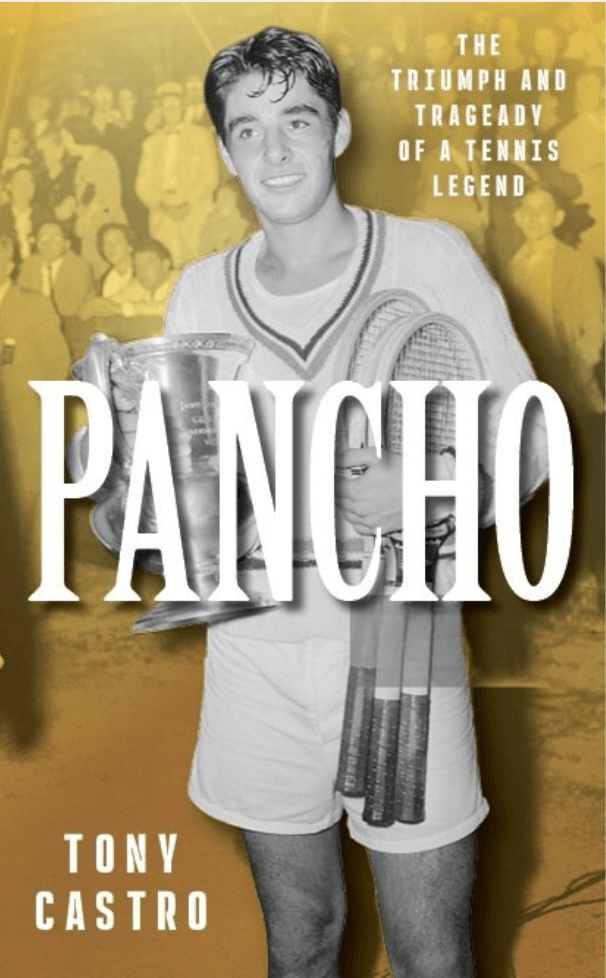
The young man smiling from the cover of Pancho: The Triumph and Tragedy of a Tennis Legend does not yet fully know what lies ahead of him. The anger, the glory, the exile, the loneliness, the greatness.
But looking back now, I think America did not fully know either.
TONY CASTRO, the former award-winning Los Angeles columnist and author, is a writer-at-large and the national political writer for LAMonthly.org. His forthcoming biography about Marilyn’s childhood and youth, THE GIRL WHO WOULD BE MARILYN MONROE, will be published in September by Bloomsbury. He can be reached at tony@tonycastro.com.
Pancho: The Triumph and Tragedy of a Tennis Legend, also from Bloomsbury, will be published in early 2027.